Attending a trade show in any industry is an opportunity for business meetings with dozens of people. How many of them are we able to remember?
Only those who will be truly memorable. This is the reason why companies are increasingly looking for alternative solutions. Those that make the most of a few minutes of contact with another person. One of the possibilities is to present business
in the virtual reality. Why?
Presentations in VR enable the recipient to move to the company and “really” experience,
what they have to offer.
Inviting him to the doorstep of the company in the virtual world allows him to get to know it better than any brochure. We can show the other person around the factory, demonstrating the systems or technologies used.
AND HOW IT LOOKS LIKE FROM THE “INSIDE”?
Such presentation can have different forms. It can be set up to allow the participant to only observe a particular space, and using hotspots to move to specific locations, e.g. to the production part, warehouses, operational part. It is a basic functionality that allows you to show production and relevant processes in a quick and uncomplicated way.
However, there is an extended option – a true interactive experience tour of the company.
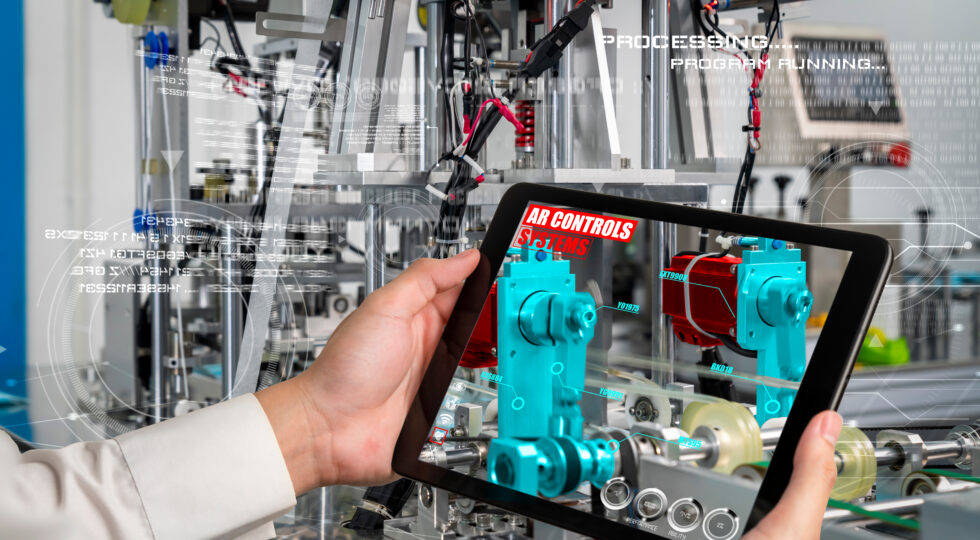
In this case, the recipient can, for example, turn on the machine, take it apart or put it back together.
Deciding to use VR technology, we have the opportunity to present not only the space or machinery itself, but the entire technological background. By presenting our solutions and technologies, we create an image of a company that is focused on continuous development and one that is not afraid of new challenges.
Creation of VR application consists of two stages. The first stage is to make a skeleton of the VR application, a prototype scene (according to the chosen method), menus and the necessary basic interactions with the environment. The second stage is the creation of graphic content and programming it in such a way that it corresponds to the project’s assumptions (e.g. disassembly into parts, showing work, machine sections, etc.). Within this phase, there are different solutions that vary in scope and amount of work.
Option number 1 – VR application based on full 3D.
We create models of the production hall, machinery and mapping of important infrastructure elements. The application can be fully interactive in this case, and moving around is freedomly. The machines can be presented in a full 3D environment and can be viewed from any perspective.
Option number 2 – VR application based on 360 degree videos and 3D models of machines.
This solution saves time and resources in creating the interior of the production hall. With 360 stp photos or videos, we can show the inside of the facility. Movement is accomplished by selecting the next of any hotspots located on the map or in space. Thanks to this, we have the opportunity to visit the hall and observe the operation of machines in a natural environment. What also enriches the application is the display of a 3D model of the machine. It can be fully interactive, i.e., as in option 1-interactive, we can show the principle of operation (manufacturing) and break it down into parts. The difference is that the presentation is done on a grayed out hall background so as to separate the footage from the 3D objects. It is worth mentioning that in addition to the VR application – for which we need special goggles – you can also create a desktop application. It fills the gap very well in case the trade show however cannot take place. This solution can also be used when you want to present your facility or offered services without the possibility of a face-to-face meeting. This option does not require a VR headset, only a computer or laptop. The application works as a kind of game.
Virtual Reality
Real interactive experience
3D models, technical drawings, photos, technical plans.
The goggles can work wirelessly and connected to a laptop. If our virtual environment is larger and contains more components, connected to a laptop will be a good option as the application is then more efficient. In addition to the goggles themselves, we also use hand controllers that allow interaction from the participant.
Of course. During the presentation, you can show an embedded presentation movie, display information about the place or device, e.g. machine dimensions, parameters, advantages of the solution. You can also include, for example, a quiz option or check questions.
Yes, it is possible. The application can be updated. You can create a simple scenario showing a certain space, and then gradually expand it with new elements.
It’s definitely worth fighting for the customer. Showing up at a trade show for the sake of showing up makes no sense. That’s where you need to make a “wow”
impression and attract a potential customer. We only get one chance to make a good first impression, and when meeting
at an industry trade show, a good impression can prove to be the basis for further conversations.
It’s also worth noting that VR applications are used not only to present a company to the outside world, but often within the company itself. An important factor is that office workers also become familiar with the production processes or, as is quite often mentioned during interviews, new employees joining the company.
In this case, having a solid base in the form of VR applications, we can create a powerful training environment.